Overview
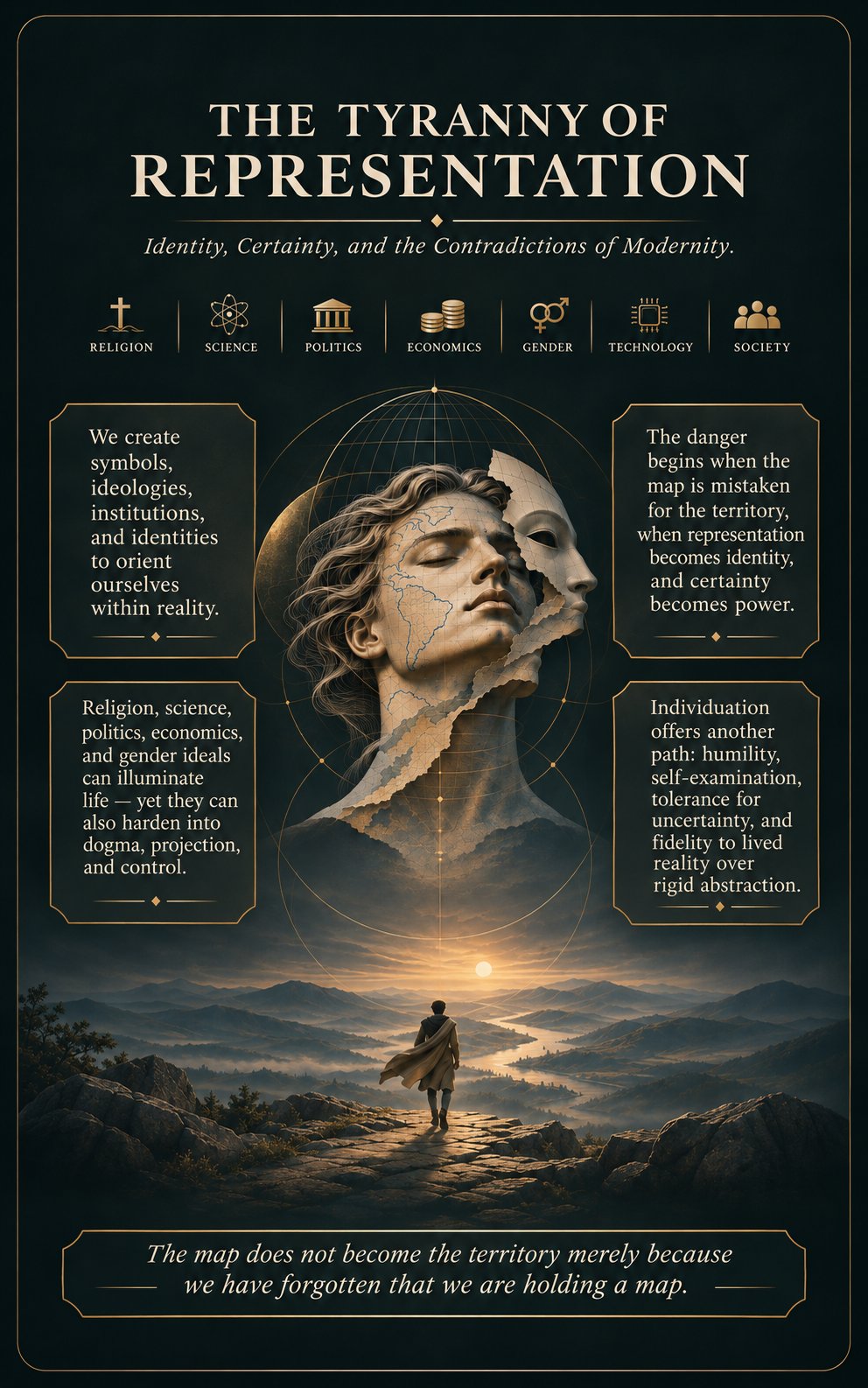
This document explores how religion, science, politics, philosophy, economics, technology, and personal identity shape our understanding of reality through symbolic representations and how these systems can become instruments of dogma, psychological projection, and social control when mistaken for reality itself. Drawing on Jungian psychology and thinkers such as Kant, Nietzsche, Arendt, and Foucault, it examines the contradictions between human progress and the pursuit of certainty, power, and control. Particular attention is given to the changing roles of women, examining how expanded freedoms have collided with persistent traditional expectations, unequal caregiving responsibilities, economic insecurity, rising living costs, psychological stress, and declining birth rates. It also explores how religious fundamentalism, political ideology, and institutional structures can reinforce these contradictions by prioritizing idealized narratives over lived human experience. Ultimately, the document advocates individuation, intellectual humility, critical self-examination, and the capacity to tolerate uncertainty, arguing that genuine wisdom comes not from possessing absolute truth but from recognizing the limitations of our beliefs, the unconscious forces shaping them, and the difference between our representations of reality and reality itself.
Part 1
The problem of representation
The argument is that religion, science, philosophical idealism, politics, economics, technology, and even our personal identities are different ways of organizing reality through representations. The danger begins when those representations become inseparable from our identity, authority, or will to power.
Religions, ideologies, politics, and identities often function as skeuomorphs of the mind and society. Making an unfamiliar or changing reality bearable by dressing it in recognizable forms is precisely what a skeuomorph does. But it isn’t merely familiar dressing; it’s the preservation of a structure that once served a function, even as the conditions surrounding that function change. What once helped humanity orient itself within reality can eventually obscure that same reality when the inherited representation becomes more important than what it was meant to represent.
Good luck trying to objectify reality without confronting the psyche’s subjective complexes, assumptions, and unconscious projections, especially when there is no standpoint entirely outside human perception from which to examine perception itself. This doesn’t make objectivity impossible; it makes it an ongoing process of correction rather than an absolute possession. Kant recognized that our experience is conditioned by the structures through which we perceive and understand it, while Cassirer extended this insight into the symbolic forms of language, myth, religion, art, and science. Enter mythos and the subtleties of theatre: humanity’s attempts to approach dimensions of experience that cannot be exhausted by any single literal description.
What’s an abstract idea but a selective model of something experienced, inferred, imagined, or once understood to be real? Alfred North Whitehead called the confusion of abstraction with concrete reality the fallacy of misplaced concreteness. Our models are indispensable precisely because reality is too complex to apprehend in its entirety, but their usefulness does not make them identical to what they describe.
Individuation, in the Jungian sense, is the lifelong process of becoming conscious of the psychological forces shaping our perceptions and judgments, recognizing the relative value of different perspectives within their proper contexts without mistaking any single, unchanging symbolic model for the entirety of reality.
The problem isn’t that humanity creates symbols, myths, religions, political structures, or scientific theories. It’s that humanity can become psychologically possessed by its own representations, forgetting that they were created to illuminate reality rather than replace it. When these representations become inseparable from personal or collective identity, challenging them can feel like an existential threat. Fundamentalism can emerge where certainty becomes a psychological necessity, and the unacknowledged shadow finds expression through projection, hostility, and the suppression of whatever contradicts the prevailing worldview.
Part 2
Knowledge, power, and the pursuit of certainty
There is a historical irony here. From Francis Bacon’s association of knowledge with power to Horkheimer and Adorno’s critique of instrumental reason, Heidegger’s technological enframing, and Foucault’s examination of knowledge and social control, a recurring contradiction emerges: systems developed to liberate humanity from ignorance can also become instruments of domination. Scientific inquiry itself is not dogmatic; its strength lies in evidence, criticism, and correction. Yet the power derived from knowledge does not automatically confer wisdom about its application. When rationality becomes concerned exclusively with prediction, efficiency, and control, the question of what can be accomplished begins to overshadow what ought to be accomplished. When science is transformed into scientism, its methods become an assumed authority over questions extending beyond their proper explanatory reach. Our power over nature grows, as does the power of those possessing specialized knowledge over those who do not.
Modern religious fundamentalism developed partly in reaction to the disruption of inherited authority by scientific discovery, historical criticism, secularization, and cultural change. Yet fundamentalism is not simply an ancient worldview resisting modern knowledge; it can also be a distinctly modern attempt to recover certainty amid accelerating change. Here lies the psychological parallel: scientism can absolutize the authority of scientific explanation, while religious fundamentalism can absolutize inherited revelation. Their claims and evidential foundations are not equivalent, but both can become rigid systems of identity and authority. Each may reinforce the other’s defensive certainties through the struggle for cultural power.
Part 3
Idealism, ideology, and institutional control
And this extends well beyond science and religion. Philosophical idealism raises profound questions about the relationship between mind and reality, but recognizing that consciousness participates in the formation of experience does not establish that reality is whatever consciousness wishes it to be. Likewise, political and moral idealism can illuminate possibilities for a better society, yet become destructive when an imagined ideal is treated as more authoritative than the actual people and circumstances it is intended to serve. An ideal should orient judgment, not abolish it. What begins as an aspiration toward human flourishing can become a justification for coercion when reality refuses to conform to the abstraction.
Politics offers a particularly visible example. Ideologies simplify complicated social realities into competing narratives of identity, virtue, blame, and salvation. As Hannah Arendt recognized in her examination of totalitarianism, an ideology can claim to explain the whole of history through the logic of a single governing idea. Political movements may then become forms of psychological theatre, where outrage reinforces belonging, opponents become vessels for projected evil, and loyalty to the narrative takes precedence over accountability to reality. The result is not necessarily greater political understanding, but an escalating competition to define whose representation of the world must prevail.
Economics, bureaucracy, and technology can reproduce the same pattern through different means. James C. Scott examined how institutions simplify complex societies into administratively manageable categories, sometimes destroying the very relationships and practical knowledge their models overlook. Markets, states, statistics, algorithms, and institutional classifications are useful instruments, but none captures the entirety of human life. When what can be measured becomes synonymous with what matters, efficiency can displace meaning, and people become abstractions within systems originally established to serve them. Even the language of liberation, progress, equality, freedom, and justice can become an instrument of domination when its professed ideals are insulated from criticism.
Part 4
Women: expanding freedom and inherited expectations
The changing position of women in modern society exposes this contradiction in particularly revealing ways. During the Kennedy administration, the establishment of the President’s Commission on the Status of Women in 1961 and passage of the Equal Pay Act in 1963 marked important developments in the pursuit of legal and economic equality. Over subsequent decades, women gained greater access to higher education, professional employment, financial independence, and reproductive autonomy. Meanwhile, American fertility declined dramatically from its postwar peak. These developments occurred alongside changing family preferences, contraception, urbanization, rising living costs, and the reorganization of economic life. Their coexistence does not establish that women’s liberation caused declining birth rates. Rather, it invites examination of how expanded opportunities interacted with institutions and expectations that often failed to evolve alongside them.
Here lies a deeper psychological and institutional contradiction: women’s opportunities expanded more rapidly than the redistribution of responsibilities traditionally assigned to them. The professional, the mother, the caregiver, the partner, and the independent individual became simultaneous social expectations, frequently without corresponding changes in domestic labor, economic security, or institutional support. Research continues to document women’s disproportionate responsibility for caregiving, including within dual-income households. Liberation from a restrictive role can become another form of pressure when society expands what a person is permitted to become without reconsidering everything that person is still expected to be. The problem is not that women possess too much freedom, but that freedom can be converted into an obligation to perform every role successfully.
Part 5
Economic pressure, caregiving, and family formation
The economic system compounds this contradiction by placing increasing financial pressure upon households whose available time and caregiving capacity remain finite. As dual-income arrangements became more common, families gained additional earning potential, but this did not guarantee a corresponding increase in economic security. Housing markets, particularly where supply is constrained, can reflect competition among households with very different purchasing power. Meanwhile, healthcare premiums, childcare expenses, and basic living costs impose substantial recurring obligations. The relationship between two-income households and rising prices is neither simple nor conclusively established as a universal causal mechanism; housing scarcity, financing conditions, policy, and other economic forces matter enormously. Nevertheless, a second income that once offered additional financial flexibility may increasingly become necessary for some households to attain housing, raise children, and withstand unexpected expenses. The economic threshold for participating in ordinary family life can rise even as the household works more hours to meet it.
This produces a particularly revealing inversion: the expansion of earning capacity does not necessarily translate into an expansion of freedom when the costs of maintaining a family absorb much of the additional income. In 2024, nearly half of American renter households spent more than 30 percent of their income on housing. By 2025, average employer-sponsored family health insurance premiums had reached nearly $27,000 annually, with workers paying a substantial share directly. Grocery prices also remained elevated after the sharp inflation of the early 2020s. These changes have different causes and histories; none can simply be attributed to women entering the workforce. But their combined consequences can make economic independence increasingly conditional upon continuous employment, debt, and the availability of multiple earners. A household may possess more nominal choices while enjoying less practical room to exercise them.
The sociologist and political philosopher Nancy Fraser identified a related contradiction in her examination of capitalism and social reproduction. Modern economies depend upon the largely unpaid labor of raising children, maintaining households, caring for relatives, and sustaining the relationships necessary for society to function, yet the organization of paid employment can undermine the very time and resources required for those activities. The economy measures productivity while often excluding the labor that makes productivity possible. As the demands of paid work expand and caregiving is increasingly purchased through markets, the value of care becomes visible as an expense while its human necessity remains inadequately recognized. The result can be a crisis in which families are expected to supply both greater economic output and greater personal care, without possessing the time, resources, or support to satisfy both demands.
Women can experience this conflict especially acutely because the redistribution of unpaid labor has not consistently matched their expanded participation in paid employment. The invisible cognitive work of anticipating needs, organizing appointments, managing children’s schedules, arranging care, and maintaining family relationships remains disproportionately assigned to mothers in many households. Research associates unequal cognitive domestic labor with psychological stress, burnout, depression, and diminished well-being. Financial insecurity compounds these burdens, as reflected in surveys finding greater reported financial stress among women than men. This does not establish that modern gender equality caused an increase in anxiety disorders, nor does it negate the substantial benefits of greater autonomy. It reveals instead that formal equality can coexist with unequal practical obligations, producing stress that neither traditional nor modern ideals adequately acknowledge.
Religious fundamentalism can further intensify these contradictions when inherited representations of femininity, marriage, motherhood, and obedience are treated as immutable moral prescriptions rather than historically conditioned ideals. A woman may be expected to achieve economic independence while remaining the self-sacrificing embodiment of traditional domestic virtue. Conversely, secular ideals of empowerment may themselves become rigid expectations of uninterrupted productivity, professional achievement, and personal self-sufficiency. Both traditionalism and progress can become forms of psychological theatre when they substitute an idealized image of womanhood for the complexity of individual women. Religion can also provide belonging, stability, and psychological support; the contradiction emerges most sharply where conformity to an identity is demanded without regard for an individual’s actual circumstances.
The health implications deserve serious consideration without reducing biology to ideology. Women experience anxiety disorders more frequently than men, while autoimmune diseases disproportionately affect women for reasons involving immune regulation, genetics, hormones, and environmental influences. Research has associated severe stress-related disorders with subsequent autoimmune disease, suggesting that psychological and physiological burdens cannot always be considered in isolation. Yet no evidence establishes that women’s expanding rights, modern employment arrangements, or changing gender roles caused the historical rise in autoimmune illness. To claim otherwise would reproduce the very error this document criticizes: forcing complex biological and social realities into a single explanatory model. The defensible question is how competing expectations, unequal responsibilities, economic insecurity, chronic stress, and insufficient support may interact with existing biological and psychological vulnerabilities.
Perhaps the demographic contradiction is even more revealing. Societies may idealize motherhood while making parenthood increasingly expensive, celebrate women’s participation in the economy while leaving care disproportionately to women, and invoke the sanctity of family while organizing employment and housing around conditions that complicate family formation. OECD research identifies housing affordability and labor-market conditions among the factors associated with fertility rates, although much of the decline remains unexplained and many people voluntarily prefer smaller families or no children. Falling fertility should therefore not be interpreted as a simple rejection of motherhood, a consequence of women’s rights, or proof of collective psychological illness. It may also reflect a growing separation between the idealized conditions of family life and the material circumstances under which families must actually be formed.
A society can therefore proclaim the freedom to pursue a career, the moral importance of raising children, and the economic necessity of continuous productivity while failing to provide the conditions under which these ideals can be reconciled. The resulting tension is not merely an individual failure to manage time, money, or relationships; it can be a structural contradiction hidden beneath competing narratives of progress, tradition, and personal responsibility. When those narratives become dogmatic, the actual distress experienced by individuals is interpreted as a failure to embody the ideal rather than as evidence that the ideal, its application, or the institutions surrounding it may require revision.
Part 6
Young men: changing opportunities and masculine identity
The changing position of young men in modern society reveals a parallel contradiction. Traditional expectations of masculinity continue to associate male identity with financial independence, competence, confidence, emotional restraint, and the capacity to provide for a family. Yet the economic and social conditions that once supported these ideals have undergone substantial transformation. Educational attainment has diverged between young men and women, traditional employment pathways have weakened for some men, and rising housing and family expenses have complicated the transition into independent adulthood. The problem is not that women have gained opportunities, but that inherited expectations of manhood have not consistently adapted to a society in which economic security, partnership, and social belonging are increasingly difficult to establish.
The psychological consequences extend beyond financial insecurity. Young men may find themselves caught between competing representations of masculinity: the traditional provider, the emotionally self-sufficient individual, the progressive and emotionally available partner, and the successful entrepreneur whose value is demonstrated through wealth, appearance, and status. These ideals are not necessarily incompatible, but they can become contradictory when treated as universal obligations rather than possibilities within individual circumstances. What should be a process of developing one’s character can become an exhausting performance of socially prescribed identity. From a Jungian perspective, the masculine persona risks becoming a rigid substitute for the whole individual, while vulnerability, dependency, uncertainty, and unmet emotional needs are driven into the shadow.
Digital culture can intensify this contradiction by transforming masculine insecurity into a market for certainty. Influencers and ideological communities offer competing explanations for male frustration, sometimes providing constructive guidance, but also promoting rigid hierarchies of status, attractiveness, wealth, and sexual success. Where genuine problems of alienation and economic insecurity are reduced to narratives of betrayal or competition between men and women, psychological distress can be redirected into resentment and political hostility. Here the original contradiction becomes self-reinforcing: the representation of successful masculinity becomes the standard by which men judge their own inadequacy, while the resulting frustration is offered as evidence that the representation must be defended more aggressively.
The deeper issue is not the disappearance of masculinity, but the danger of mistaking any inherited or newly manufactured image of manhood for the entirety of male identity. A society that demands emotional resilience without encouraging emotional connection, financial success without ensuring reasonable opportunities, and family responsibility without supporting family formation risks interpreting structural contradictions as individual failures. Just as women’s expanded freedoms have not eliminated inherited expectations, men’s changing circumstances have not necessarily liberated them from traditional measures of worth. Both reveal how representations intended to provide orientation can become instruments of psychological confinement when they cease to accommodate the complexity of human experience.
When a society changes the conditions of human life faster than it revises its expectations of human identity, individuals can experience the resulting contradictions as personal inadequacy rather than recognizing them as limitations of the social models they have inherited.
Part 7
When the map replaces the territory
The deeper contradiction is not between religion and science, idealism and materialism, men and women, or the political left and right. It is between the necessity of forming representations and the psychological temptation to mistake those representations for reality itself. Nietzsche’s perspectivism offers a useful corrective: greater objectivity need not arise from pretending to possess a perspective-free view, but from developing the ability to examine, compare, and correct multiple perspectives. The goal is not to eliminate judgment or pretend every interpretation is equally valid, but to become less possessed by the particular standpoint from which we judge.
Nature always takes its revenge; it is a rebalancing. Whatever our systems suppress, exclude, or fail to account for does not simply cease to exist. Our limitations eventually confront us through consequences our models could not accommodate. What is neglected in the psyche can reappear through projection and conflict; what is neglected in society can reappear through alienation and resistance; what is neglected in nature can return through ecological consequences. The pattern need not imply that nature possesses intentions. It is enough that reality remains larger than the abstractions through which we attempt to control it.
Part 8
Uncertainty, faith, and intellectual humility
We must therefore cultivate what John Keats called negative capability: the capacity to remain amid uncertainties, mysteries, and doubts without an irritable reaching after premature explanations. Yet educational systems too often reward the reproduction of answers over the patience, imagination, self-examination, and discernment necessary to question them. Education should not merely teach us what to think, or even how to reason, but how to recognize the limitations of our reasoning, the influence of our psychological investments, and the difference between understanding something and merely possessing an explanation for it. This is a lifelong process and must remain so.
The ability to remain with uncertainty and mystery without compulsively resolving them into explanations is one of the foundations of peace. This does not require abandoning facts, reason, or evidence. It requires distinguishing justified confidence from psychological certainty, and recognizing when our demand for an answer is serving the pursuit of truth rather than the desire for emotional security or control.
This is also where the distinction between certainty and faith becomes important. Certainty seeks closure; faith, at its most mature, can sustain commitment without demanding that mystery be abolished. We can act upon our best understanding without pretending that our understanding is complete. Humility does not mean having no convictions, but remaining capable of revising them without experiencing their revision as the destruction of ourselves.
Part 9
The danger of turning the critique into dogma
And finally, this post, Jung’s psychology, individuation, and even the critique of dogma can themselves become dogma or expressions of the will to power. A person can become just as possessed by the belief that they have transcended ideology as another person is possessed by ideology itself. This is perhaps the most subtle psychological trap: mistaking the recognition of one’s projections for immunity from further projection. No theory, however comprehensive, escapes the conditions of the mind that produced it.
The purpose is not to escape symbolism, abstraction, reason, or belief. That would be impossible. It is to remain conscious of their provisional nature, their proper applications, their limitations, and the human motives that can transform them from instruments of understanding into instruments of domination.
The aim is not to become certain of everything, nor uncertain of everything, but to develop the wisdom to distinguish what we know, what we reasonably believe, what we merely assume, and what remains beyond our understanding.
Footnotes
Perhaps the greatest achievement of individuation is not freedom from ideology, but consciousness of our need for it so that we no longer mistake psychological security for truth.
The truth we can put into words is always a representation of truth, never its entirety. The map does not become the territory merely because we have forgotten that we are holding a map.